
- Published
- Updated
- Reading time
- 3 minutes
- Filed under
- sources · methodology · claim intelligence
KnitKnot field note
Not all citations are equal
A source linked to the recommendation deserves a different review from a background reference. Neither citation proves that the publisher controlled the answer.

Max Wiesner
Co-founder, KnitKnot
 Evidence plate / sourcesObserved · sourced · reviewed
Five sources, one answer
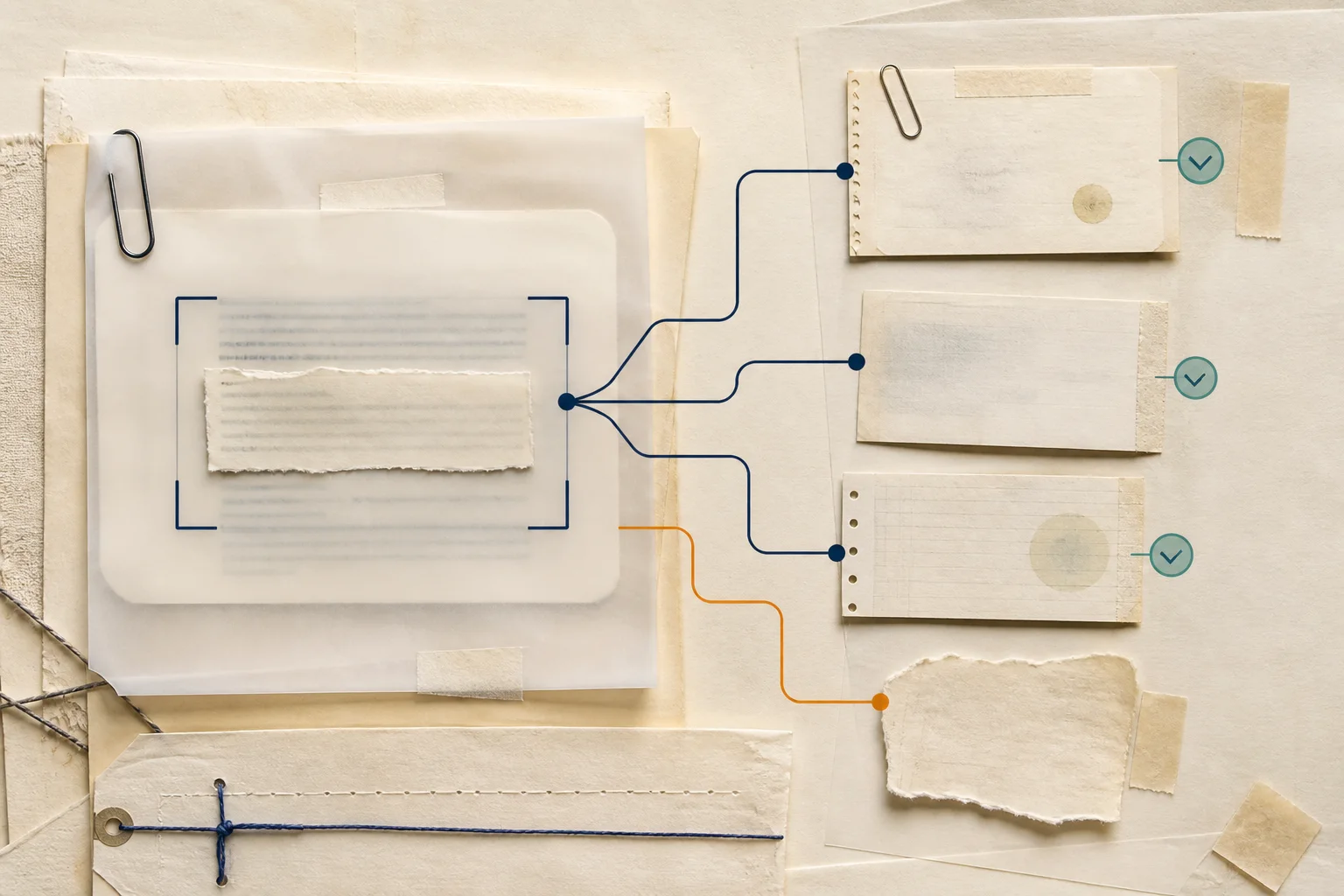
One source might support the recommendation. Another might provide a single statistic. A third might appear in the source panel without a clear connection to anything the buyer reads. Counting them as equivalent loses that distinction.
A count still answers a useful question: how often did your pages appear in the responses you checked? It leaves another question open. What does the answer actually say alongside those citations?
What does a citation tell you?
A citation associates a page with part of the generated answer. You still need to open the page and check whether it supports the statement. A real URL can sit beside a claim the page never made.
A source panel is less specific. OpenAI’s search documentation explains that ChatGPT can show other relevant links alongside cited sources. Being listed does not establish that a page supplied a particular claim.
That distinction changes the investigation. If the answer misstates your deployment options, check the linked passage before asking its publisher for a correction.
What do we mean by source gravity?
We use source gravity to describe an estimate of how closely a cited source connects to the substance of an answer. A page associated with the recommendation or a disputed comparison deserves more attention than a general background reference.
The estimate comes from observable evidence, such as citation placement and the relationship between the source passage and the answer’s wording. It does not expose the model’s internal reasoning. Our earlier framing that a publisher “controlled the answer” overstated what those observations establish.
Consider an illustrative comparison with five sources: your documentation, two competitor posts, an analyst report, and a community thread. Counting owners gives you a useful inventory. Reading the passages might reveal that your documentation supports the integration detail while a competitor post is cited beside the price comparison. You now have specific statements to verify.
You do not yet know whether removing the competitor post would change the recommendation. That is a separate question requiring different evidence.
Why does source ownership matter?
A competitor has an interest in how it describes your product. So does your company. Ownership tells the reviewer whose perspective a page represents; it does not decide whether the claim is true.
Start with the facts that matter to the buying requirement. Check the plan, effective date, and conditions. A competitor’s comparison may be correct. Your own page may need an update. Keep that possibility open while reviewing the evidence.
Repeated citations can help prioritize the work. A page that appears across several relevant answers is worth inspecting. Report the number of appearances and the sample checked instead of treating repetition as a measure of the publisher’s authority over the model.
What should you do with the finding?
If a cited statement conflicts with approved product evidence, preserve the discrepancy and identify who owns the source. Correct your own page or prepare a factual request to the other publisher. If the source does not support the answer’s wording, record that mismatch without attributing the invented wording to the publisher.
If the comparison is accurate but leaves your strengths unexplained, write a useful comparison for the buyer’s actual requirements. Include conditions and limitations. A new page gives readers another source to inspect; later captured answers show whether it appeared in the responses you checked.
KnitKnot’s claim intelligence keeps source wording beside the attributed AI statement and the approved fact. The source-tracing guide walks through one investigation. Use it to check the passage behind the citation before deciding what to change.